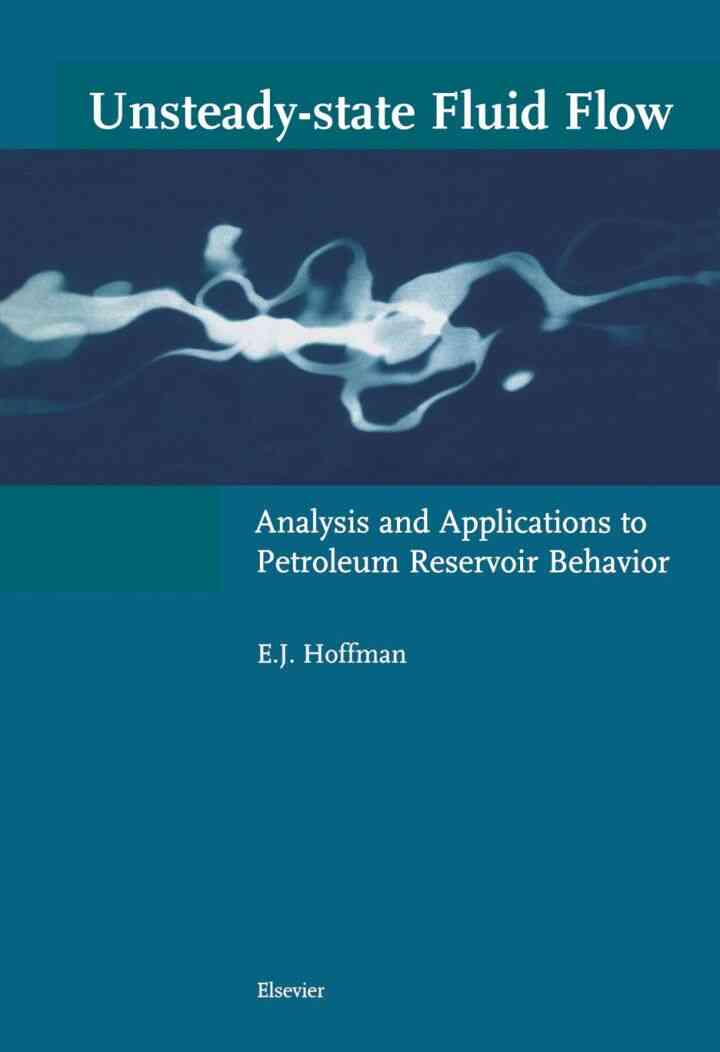
Unsteady-state Fluid Flow: Analysis and Applications to Petroleum Reservoir Behavior
In stock
Unsteady-state Fluid Flow: Analysis and Applications to Petroleum Reservoir Behavior
$294.00
The ubiquitous examples of unsteady-state fluid flow pertain to the production or depletion of oil and gas reservoirs.
After introductory information about petroleum-bearing formations and fields, reservoirs, and geologic codes, empirical methods for correlating and predicting unsteady-state behavior are presented. This is followed by a more theoretical presentation based on the classical partial differential equations for flow through porous media.
Whereas these equations can be simplified for the flow of (compressible) fluids, and idealized solutions exist in terms of Fourier series for linear flow and Bessel functions for radial flow, the flow of compressible gases requires computer solutions, read approximations. An analysis of computer solutions indicates, fortuitously, that the unsteady-state behavior can be reproduced by steady-state density or pressure profiles at successive times. This will demark draw down and the transition to long-term depletion for reservoirs with closed outer boundaries.
As an alternative, unsteady-state flow may be presented in terms of volume and surface integrals, and the methodology is fully developed with examples furnished. Among other things, permeability and reserves can be estimated from well flow tests. The foregoing leads to an examination of boundary conditions and degrees of freedom and raises arguments that the classical partial differential equations of mathematical physics may not be allowable representations.
For so-called open petroleum reservoirs where say water-drive exists, the simplifications based on successive steady-state profiles provide a useful means of representation, which is detailed in the form of material balances.
Unsteady-State Fluid Flow provides: empirical and classical methods for correlating and predicting the unsteady-state behavior of petroleum reservoirs' analysis of unsteady-state behavior, both in terms of the classical partial differential equations, and in terms of volume and surface integrals' simplifications based on successive steady-state profiles which permit application to the depletion of both closed reservoirs and open reservoirs, and serves to distinguish drawdown, transition and long-term depletion performance.
Book Details
- Author: Hoffman, E.J.
- Publisher: Elsevier Science
- eBook ISBN: 9780444501844, 9780080543451, 0080543456
- Print ISBN: 9780444501844, 0444501843
Product Details
You May Also Like
View all →
Advances in Computer Science and Information Technology: First International Conference on Computer Science and Information Technology, CCSIT 2011, Bangalore, India, January 2-4, 2011. Proceedings, Part I

Designing Democracy Re-education and the America Houses (19451961)- The American Information Centers and their Involvement in Democratic: Re-education in Western Germany and West Berlin from 1945 to 1961

Advances in Neuroergonomics and Cognitive Engineering: Proceedings of the AHFE 2016 International Conference on Neuroergonomics and Cognitive Engineering, July 27-31, 2016, Walt Disney World®, Florida, USA