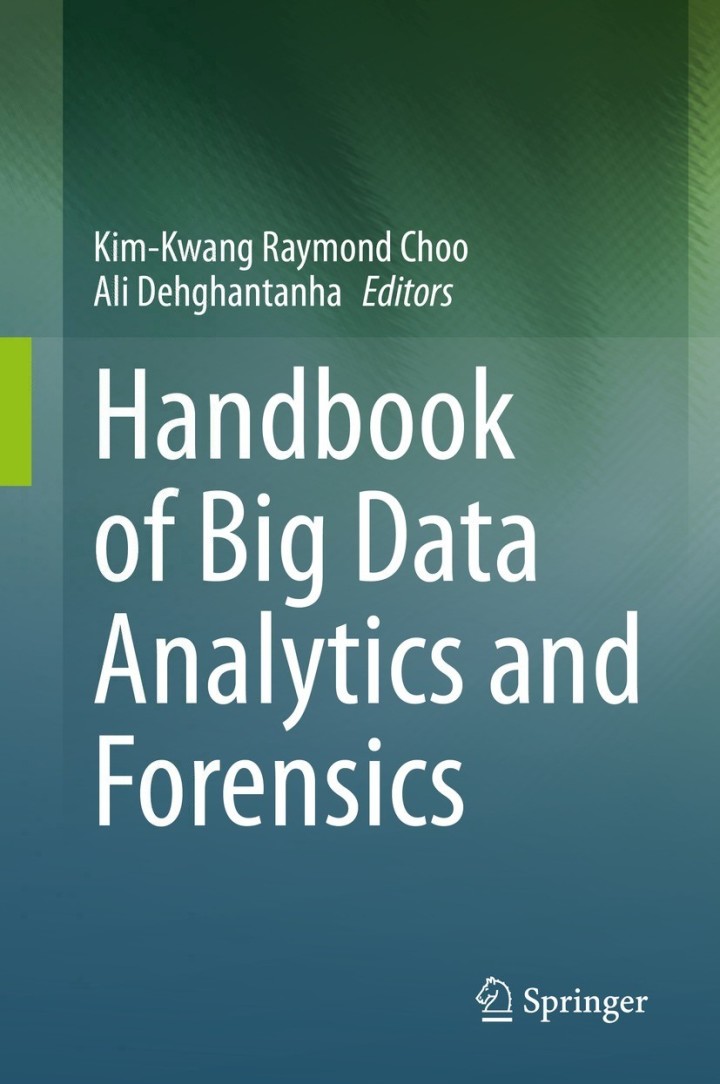
Handbook of Big Data Analytics and Forensics
In stock
Handbook of Big Data Analytics and Forensics
$16.00
This handbook discusses challenges and limitations in existing solutions, and presents state-of-the-art advances from both academia and industry, in big data analytics and digital forensics. The second chapter comprehensively reviews IoT security, privacy, and forensics literature, focusing on IoT and unmanned aerial vehicles (UAVs). The authors propose a deep learning-based approach to process cloud's log data and mitigate enumeration attacks in the third chapter.
The fourth chapter proposes a robust fuzzy learning model to protect IT-based infrastructure against advanced persistent threat (APT) campaigns. Advanced and fair clustering approach for industrial data, which is capable of training with huge volume of data in a close to linear time is introduced in the fifth chapter, as well as offering an adaptive deep learning model to detect cyberattacks targeting cyber physical systems (CPS) covered in the sixth chapter.
The authors evaluate the performance of unsupervised machine learning for detecting cyberattacks against industrial control systems (ICS) in chapter 7, and the next chapter presents a robust fuzzy Bayesian approach for ICS's cyber threat hunting. This handbook also evaluates the performance of supervised machine learning methods in identifying cyberattacks against CPS. The performance of a scalable clustering algorithm for CPS's cyber threat hunting and the usefulness of machine learning algorithms for Mac OS malware detection are respectively evaluated.
This handbook continues with evaluating the performance of various machine learning techniques to detect the Internet of Things malware. The authors demonstrate how Mac OSX cyberattacks can be detected using state-of-the-art machine learning models. In order to identify credit card frauds, the fifteenth chapter introduces a hybrid model. In the sixteenth chapter, the editors propose a model that leverages natural language processing techniques for generating a mapping between APT-related reports and cyber kill chain.
A deep learning-based approach to detect ransomware is introduced, as well as a proposed clustering approach to detect IoT malware in the last two chapters. This handbook primarily targets professionals and scientists working in Big Data, Digital Forensics, Machine Learning, Cyber Security Cyber Threat Analytics and Cyber Threat Hunting as a reference book. Advanced level-students and researchers studying and working in Computer systems, Computer networks and Artificial intelligence will also find this reference useful.
Book Details
- Publisher: Springer
- eBook ISBN: 9783030747534, 3030747530
- Print ISBN: 9783030747527, 3030747522
Product Details
You May Also Like
View all →
Advances in Computer Science and Information Technology: First International Conference on Computer Science and Information Technology, CCSIT 2011, Bangalore, India, January 2-4, 2011. Proceedings, Part I

Designing Democracy Re-education and the America Houses (19451961)- The American Information Centers and their Involvement in Democratic: Re-education in Western Germany and West Berlin from 1945 to 1961

Advances in Neuroergonomics and Cognitive Engineering: Proceedings of the AHFE 2016 International Conference on Neuroergonomics and Cognitive Engineering, July 27-31, 2016, Walt Disney World®, Florida, USA