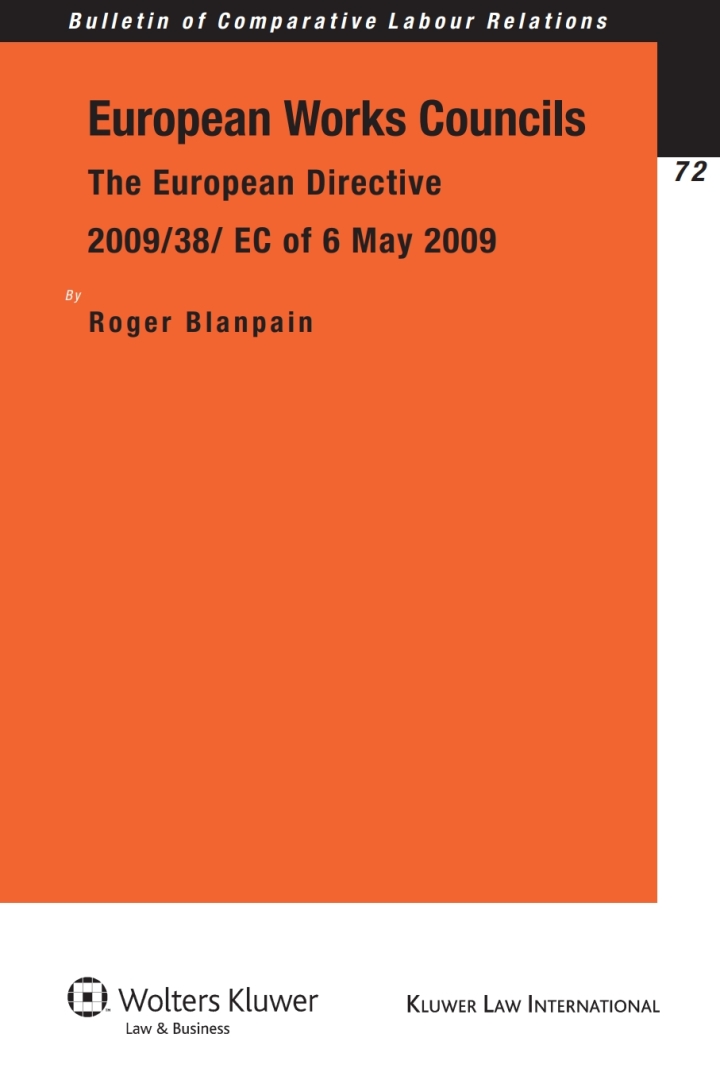
European Works Councils: The European Directive 2009/38/EC of 6 May 2009
In stock
European Works Councils: The European Directive 2009/38/EC of 6 May 2009
$63.00
Involvement of employees in the social dialogue has always been an ongoing and vigorous concern of the European Union.
Over the years since the European Works Councils (EWCs) were established in 1994, expectations regarding their role have grown, particularly in anticipating and managing change as corporate activities have become increasingly internationalized. Finally, after fifteen years of ongoing debate, Directive 2009/28/EC, establishing a new legal framework for EWCs, took effect in June 2009, with Member States obligated to implement the new rules at national level by June 2011.
The 2009 Directive is intended to ensure that employees' transnational information and consultation rights are effective, to increase the number of European Works Councils established, to strengthen the legal certainty of negotiated outcomes involving EWCs, and to ensure that the directives on information and consultation of employees are better linked. This essential guide is the first publication to annotate and analyze the new Directive.
It describes the many changes from the previous Council Directive 94/45/EC, and expertly traces the legislative history through all the intervening preparatory documents.
It examines the most important provisions in depth, shedding clear light on such issues as the following: - the new definitions of "information" and "consultation"; - the nature of the stronger links between national and transnational levels of employee information and consultation; - employers' obligation to pass on information to local representatives of employees; - training of EWC members; - the composition of the Special Negotiating Body (SNB); - the presence of experts, including trade union representatives, in negotiation meetings; - employee representatives' right to collectively represent the employees; - the role of EWCs and workers' representatives in the EU's merger control procedures; - fall-back rules that improve EWCs' consultation in case of restructuring; and - provisions ensuring that EWCs are informed and consulted without calling into question the company's capacity to adapt.
The author's insightful perspectives - e.g., on how the courts are likely to interpret such phrases as "rights arising from the directive" in specific contexts - add greatly to the practical value of the analysis. Annexes include virtually all relevant primary documents, encompassing pronouncements of the Commission, the Parliament, the social partners, and the European Economic and Social Committee.
Beyond a doubt, this timely bulletin is essential reading for representatives of multinational enterprises operating in the EU, labour law and industrial relations scholars, representatives of trade unions and employers' associations, human resources professionals, lawyers negotiating EWC agreements, and concerned policymakers and government officials. V.
Book Details
- Author: Roger Blanpain
- Publisher: Kluwer Law International B
- eBook ISBN: 9789041158147, 9041158146
- Print ISBN: 9789041132086, 9041132082
Product Details
You May Also Like
View all →
Advances in Computer Science and Information Technology: First International Conference on Computer Science and Information Technology, CCSIT 2011, Bangalore, India, January 2-4, 2011. Proceedings, Part I
Designing Democracy Re-education and the America Houses (19451961)- The American Information Centers and their Involvement in Democratic: Re-education in Western Germany and West Berlin from 1945 to 1961

Advances in Neuroergonomics and Cognitive Engineering: Proceedings of the AHFE 2016 International Conference on Neuroergonomics and Cognitive Engineering, July 27-31, 2016, Walt Disney World®, Florida, USA